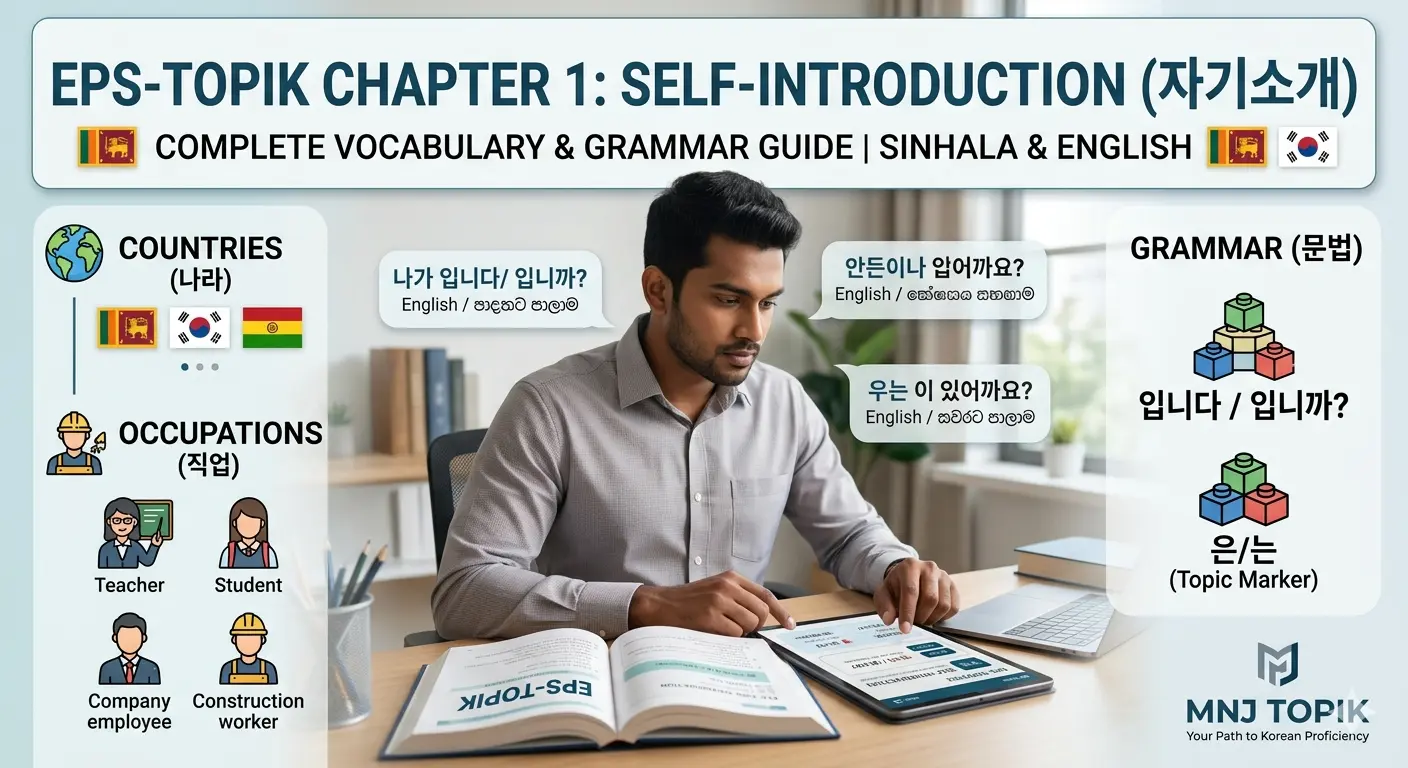
Welcome to the comprehensive guide for EPS-TOPIK Chapter 1 Listening Exercises (듣기). As you prepare to work in South Korea, understanding spoken Korean is absolutely crucial. This lesson covers 자기소개 (Self-introduction) with a focus on nationalities and occupations.
ආයුබෝවන් දරුවනේ! MNJ TOPIK වෙතින් ගෙන එන EPS-TOPIK පෙළපොතේ "자기소개" (ස්වයං හැඳින්වීම) පාඩමේ සවන්දීමේ (듣기) අභ්යාස මාලාවට ඔබව සාදරයෙන් පිළිගන්නවා. කොරියාවේ රැකියාවකට යාමට බලාපොරොත්තු වන ඔබට, අන් අය පවසන දේ නිවැරදිව තේරුම් ගැනීම අතිශයින් වැදගත් වේ.
In this professor-level study guide we analyse each listening question, break down the grammar, provide vocabulary with synonyms (유의어), and give you proven strategies to ace the EPS-TOPIK exam.
📌 Question 1 — Identifying Countries (රටවල් හඳුනාගැනීම)
Instruction (උපදෙස්):
다음을 듣고 빈칸에 알맞은 것을 고르십시오.
Listen to the following and choose the correct word for the blank.
පහත සඳහන් දේ අසා හිස්තැනට ගැළපෙන දේ තෝරන්න.
Audio Script (ශ්රව්ය පිටපත): "태국" — Thailand (තායිලන්තය)
Options (පිළිතුරු):
- 태 (Tae)
- 미 (Mi)
- 수 (Su)
- 조 (Jo)
✅ Correct Answer: ① 태
Professor's Analysis (විශ්ලේෂණය):
The blank is followed by the suffix 국 (Guk), meaning "country / nation". The audio pronounces 태국 (Thailand), so the missing syllable is 태.
හිස්තැනට පසුව ඇති '국' (ගුක්) යන්නෙන් අදහස් වන්නේ 'රට' යන්නයි. ශ්රව්ය පටයේ කියවෙන්නේ '태국' (තේගුක් / තායිලන්තය) යන්න බැවින් නිවැරදි පිළිතුර ① '태' යන්නයි.
📚 Vocabulary Breakdown (වචන මාලාව)
- 태국 (Tae-guk): Thailand — තායිලන්තය
- 미국 (Mi-guk): USA — ඇමරිකාව
- 수국 (Su-guk): Hydrangea flower (not a country) — මලක් (රටක් නොවේ)
- 조국 (Jo-guk): Motherland / Fatherland — මව්බිම
Synonyms (유의어 / සමාන පද): 고향 (hometown), 모국 (mother country)
📌 Questions 2–3 — Responding to Questions (ප්රශ්නවලට පිළිතුරු දීම)
Instruction (උපදෙස්):
[2~3] 다음을 듣고 물음에 알맞은 대답을 고르십시오.
Listen to the following and choose the correct answer to the question.
පහත දෑ අසා ප්රශ්නයට ගැළපෙන පිළිතුර තෝරන්න.
📝 Question 2 — Occupations (රැකියාවන්)
👩 회사원입니까?
Are you a company employee? / ඔබ සමාගම් සේවකයෙක්ද?
Options (පිළිතුරු):
- 네, 회사원입니다. — Yes, I am a company employee. / ඔව්, මම සමාගම් සේවකයෙක්. ✅
- 네, 회사원이 있습니다. — Yes, there is a company employee. / ඔව්, සමාගම් සේවකයෙක් ඉන්නවා.
- 아니요, 회사원이 많습니다. — No, there are many employees. / නැහැ, සමාගම් සේවකයින් ගොඩක් ඉන්නවා.
- 아니요, 회사원이 좋습니다. — No, employees are good. / නැහැ, සමාගම් සේවකයින් හොඳයි.
✅ Correct Answer: ① 네, 회사원입니다.
Grammar Note (ව්යාකරණ සටහන):
The question ends with the formal interrogative ~입니까? (~imnikka). The only grammatically and contextually correct response pairs it with the formal declarative ~입니다 (~imnida). Options ②③④ use the verbs 있다 (exist), 많다 (many), 좋다 (good) — none of which answer a yes/no identity question.
~입니까? ප්රශ්නයකට පිළිතුර ~입니다 ස්වරූපයෙන් විය යුතුය. ②③④ භාවිත කරන ක්රියා (있다, 많다, 좋다) ව්යාකරණානුකූලව සහ අර්ථ අතරින් ද නොගැළපේ.
📝 Question 3 — Nationalities (ජාතීන්)
어느 나라 사람입니까?
Which country are you from? / ඔබ කොයි රටේ කෙනෙක්ද?
Options (පිළිතුරු):
- 남자입니다. — I am a man. / පිරිමියෙක්.
- 기술자입니다. — I am a technician. / කාර්මිකයෙක්.
- 서른 살입니다. — I am 30 years old. / වයස අවුරුදු තිහයි.
- 네팔 사람입니다. — I am Nepalese. / නේපාල ජාතිකයෙක්. ✅
✅ Correct Answer: ④ 네팔 사람입니다.
Professor's Analysis (විශ්ලේෂණය):
The question word 어느 means "which". 어느 나라 사람 = "person of which country". The answer must name a nationality. Option ④ is the only nationality; ① is gender (성별), ② is occupation (직업), ③ is age (나이).
'어느 나라 사람입니까?' — රටක් ගැන ඇසූ ප්රශ්නයකට ජාතිය කියා පිළිතුරු දිය යුතුය. ① (ස්ත්රී පුරුෂ භාවය), ② (රැකියාව), ③ (වයස) කිසිවක් නොගැළපේ.
📚 Key Grammar Patterns (ඉලක්කගත ව්යාකරණ)
- Noun + 입니까? — Formal question: "Is it …?" (අචාරශීලිව ප්රශ්නය)
- Noun + 입니다. — Formal statement: "It is …." (අචාරශීලිව ප්රකාශය)
- 어느 나라 사람입니까? — "Which country are you from?" (ජාතිය විමසීම)
📌 Questions 4–5 — Identifying the Topic (ප්රධාන මාතෘකාව)
Instruction (උපදෙස්):
[4~5] 두 사람은 무엇에 대해 말하고 있습니까?
What are the two people talking about?
මේ දෙදෙනා කුමක් ගැන කතා කරන්නේද?
📝 Question 4 — Dialogue about Nationality (ජාතිය ගැන දෙබස)
👩 여: 안녕하세요? 저는 네팔 사람입니다.
Hello. I am from Nepal. / ආයුබෝවන්, මම නේපාල ජාතිකයෙක්.
👨 남: 안녕하세요? 저는 몽골 사람입니다.
Hello. I am from Mongolia. / ආයුබෝවන්, මම මොංගෝලියානු ජාතිකයෙක්.
Options (පිළිතුරු):
- 이름 — Name / නම
- 나이 — Age / වයස
- 국적 — Nationality / ජාතිය ✅
- 성별 — Gender / ස්ත්රී පුරුෂ භාවය
✅ Correct Answer: ③ 국적
Professor's Tip (විශේෂ උපදෙස්):
Listen for the pattern [Country] + 사람입니다 — it always signals 국적 (nationality). Both speakers state their countries, so they are discussing nationalities, not names, age, or gender.
[රටේ නම] + 사람입니다 ශ්රව්ය ආකෘතිය ජාතිය (국적) ගැන කතා කරන බව නිශ්චිතවම පෙන්නුම් කරයි.
📝 Question 5 — Dialogue about Occupation (රැකියාව ගැන දෙබස)
👨 남: 어부입니까?
Are you a fisherman? / ඔබ ධීවරයෙක්ද?
👩 여: 아니요. 저는 농부입니다.
No. I am a farmer. / නැහැ. මම ගොවියෙක්.
Options (පිළිතුරු):
- 고향 — Hometown / උපන් ගම
- 직업 — Occupation / රැකියාව ✅
- 이름 — Name / නම
- 국적 — Nationality / ජාතිය
✅ Correct Answer: ② 직업
Vocabulary & Synonyms (වචන සහ සමාන පද):
- 어부 (Eo-bu): Fisherman — ධීවරයා
- 농부 (Nong-bu): Farmer — ගොවියා
- 직업 (Jig-eop): Job / Occupation — රැකියාව
Synonym (유의어): 일 (work), 하는 일 (what one does) - 고향 (Go-hyang): Hometown — උපන් ගම
Synonym (유의어): 출생지 (birthplace) - 이름 (I-reum): Name — නම
Honorific (높임말): 성함 (polite name)
Professor's Analysis (විශ්ලේෂණය):
The exchange of job titles — 어부 (fisherman) and 농부 (farmer) — clearly places this dialogue under 직업 (occupation).
දෙබසේ ධීවරයා (어부) සහ ගොවියා (농부) ලෙස රැකියා නම් ඇසෙන නිසා, මෙහි මාතෘකාව 직업 (රැකියාව) වේ.
🎯 EPS-TOPIK Listening Strategy — Exam Tips
Mastering the EPS-TOPIK 듣기 (Listening) section requires focusing on two things: grammar endings and topic keywords.
- When you hear ~입니까?, expect the answer to follow the ~입니다 pattern with a matching noun.
- Country names followed by 사람 always point to 국적 (nationality) as the topic.
- Job titles like 어부, 농부, 회사원 always point to 직업 (occupation) as the topic.
- Distractors in options usually swap categories: age (나이), gender (성별), name (이름), hometown (고향).
දෛනිකව මෙම වචන සහ ව්යාකරණ ආකෘති පුරුදු කරන්න. විභාගයේදී ශ්රව්ය පටයට ඉතා හොඳින් සවන් දී මූලික ශ්රව්ය ඉඟි හරහා ඉක්මනින් පිළිතුර ග්රහණය කරගැනීමට මෙය ඔබට විශාල රුකුලක් වනු ඇත.
මීළඟ පාඩමෙන් (EPS-TOPIK Chapter 2 — 생활용품 / දෛනික අවශ්යතා) නැවත හමුවෙමු!
Good luck with your EPS-TOPIK preparation — MNJ TOPIK is with you every step of the way! 🇱🇰🇰🇷