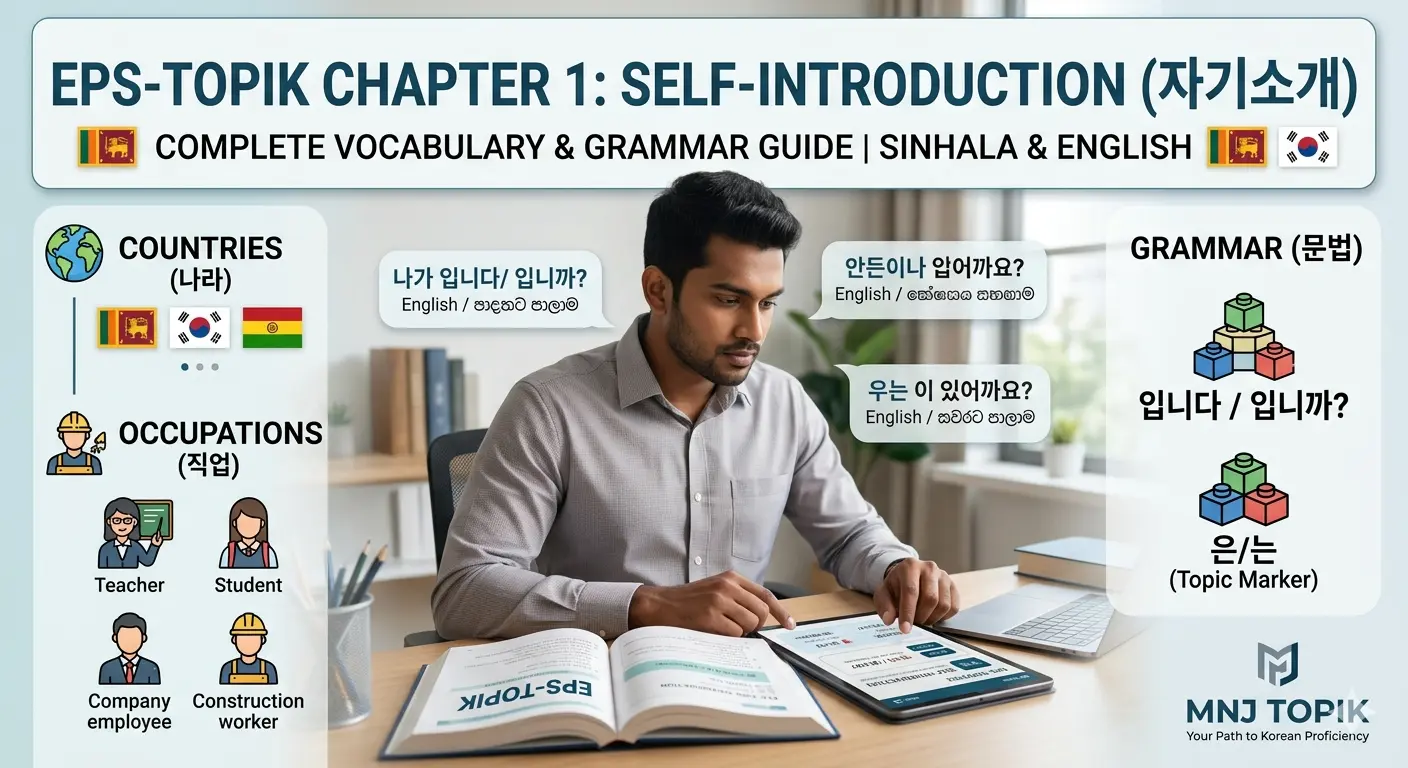
Welcome to the comprehensive Reading, Vocabulary, and Grammar guide for EPS-TOPIK Chapter 1: 자기소개 (Self-Introduction). In this foundational lesson, you will learn how to introduce yourself, state your nationality, and talk about your occupation in formal Korean.
ආයුබෝවන් දරුවනේ! MNJ TOPIK වෙතින් ගෙන එන EPS-TOPIK පෙළපොතේ "자기소개" (ස්වයං හැඳින්වීම) පළමු පාඩමේ සම්පූර්ණ මාර්ගෝපදේශයට ඔබව සාදරයෙන් පිළිගන්නවා. මෙම පාඩමෙන් අප කොරියානු භාෂාවෙන් තමන්ව හඳුන්වා දෙන ආකාරය, ජාතීන් සහ රැකියාවන් ගැන කතා කරන ආකාරය ඉගෙන ගනිමු.
📚 1. Vocabulary: Countries (나라 이름 - රටවල්)
To introduce yourself, you need to know how to state your country. In Korean, we add 사람 (person) after the country name to express our nationality.
ඔබගේ ජාතිය පැවසීම සඳහා කොරියානු භාෂාවෙන් රටේ නමට පසුව 사람 (පුද්ගලයා / ජාතිකයා) යන්න එකතු කළ යුතුය.
- 한국 (Han-guk): Republic of Korea — කොරියාව
- 스리랑카 (Seu-ri-rang-ka): Sri Lanka — ශ්රී ලංකාව
- 네팔 (Ne-pal): Nepal — නේපාලය
- 방글라데시 (Bang-geul-la-de-si): Bangladesh — බංග්ලාදේශය
- 베트남 (Be-teu-nam): Vietnam — වියට්නාමය
- 태국 (Tae-guk): Thailand — තායිලන්තය
- 필리핀 (Pil-li-pin): The Philippines — පිලිපීනය
- 몽골 (Mong-gol): Mongolia — මොංගෝලියාව
📌 2. Grammar: 입니다 / 입니까? (Formal Copula Form)
The verb ‘to be’ in formal Korean is 입니다 (imnida) for statements and 입니까? (imnikka?) for questions. It attaches directly to the end of nouns without a space.
කොරියානු භාෂාවේ විධිමත් (formal) අවස්ථාවලදී යමක් හෝ කෙනෙක් "වේ / ය" යන්න ප්රකාශ කිරීමට 입니다 ද, ප්රශ්න ඇසීමට 입니까? ද භාවිතා කරයි.
Example 1: State your name (නම පැවසීම)
저는 다린두입니다. (I am Darindu. / මම දරින්දු වෙමි.)
Example 2: Ask and state nationality (ජාතිය විමසීම සහ පැවසීම)
가: 어느 나라 사람입니까? (Which country are you from? / ඔබ කොයි රටේ කෙනෙක්ද?)
나: 스리랑카 사람입니다. (I am Sri Lankan. / මම ශ්රී ලාංකිකයෙක්.)
📚 3. Vocabulary: Occupations (직업명 - රැකියාවන්)
Here are essential vocabulary words for different occupations you will encounter frequently in the EPS-TOPIK exam.
- 학생 (Hak-saeng): Student — ශිෂ්යයා
- 회사원 (Hoe-sa-won): Company Employee — සමාගම් සේවකයා
- 농부 (Nong-bu): Farmer — ගොවියා
- 어부 (Eo-bu): Fisherperson — ධීවරයා
- 근로자 (Geun-ro-ja): Worker — කම්කරුවා / සේවකයා
- 경찰관 (Gyeong-chal-gwan): Police Officer — පොලිස් නිලධාරියා
- 의사 (Ui-sa): Doctor — වෛද්යවරයා
- 간호사 (Gan-ho-sa): Nurse — හෙදිය
- 선생님 (Seon-saeng-nim): Teacher — ගුරුවරයා
- 기술자 (Gi-sul-ja): Technician — කාර්මිකයා
- 목수 (Mok-su): Carpenter — වඩුවා
- 운전기사 (Un-jeon-gi-sa): Driver — රියදුරා
📌 4. Grammar: 은/는 (Topic Marker - මාතෘකා නිපාතය)
은 / 는 marks the main topic of the sentence. If the noun ends with a final consonant (받침), use 은. If it ends with a vowel, use 는.
වාක්යයක ප්රධාන මාතෘකාව හඳුන්වා දීමට 은/는 භාවිතා කරයි. වචනය අවසන් වන්නේ විරාම අකුරකින් (Consonant / 받침) නම් 은 ද, ස්වරයකින් (Vowel) නම් 는 ද යෙදේ.
- 받침 O (Ends in Consonant): 투안 + 은 ➔ 투안은 목수입니다. (Tuan is a carpenter.)
- 받침 X (Ends in Vowel): 저 + 는 ➔ 저는 회사원입니다. (I am a company employee.)
🗣️ 5. Useful Expression: Greetings (유용한 표현)
가: 안녕하세요? 처음 뵙겠습니다.
Hello. Nice to meet you (for the first time). / ආයුබෝවන්, ඔබව මුණගැසීම සතුටක්.
나: 안녕하세요? 잘 부탁드립니다.
Hello. I look forward to working with you. / ආයුබෝවන්, මාව හොඳින් බලාගන්න (කරුණාකර සහයෝගය දක්වන්න).
🇰🇷 6. Culture & Information: Korean Greeting Etiquette (한국의 인사 예절)
Greeting manners are incredibly important in Korean culture, especially in a professional workplace environment.
කොරියානු සංස්කෘතියේ, විශේෂයෙන්ම සේවා නියුක්තියේදී සුබපැතීමේ (Greeting) ක්රමවේදයන් ඉතා වැදගත් වේ.
- Bowing (허리를 굽혀 인사하기): When greeting someone older or of higher status, you should say "안녕하세요?" or "안녕하십니까?" while bowing your head and bending at the waist as a strict sign of respect.
- Waving (손을 흔들어 인사하기): When greeting closer friends or those younger than you, a light wave and stating "안녕?" is acceptable.
- Shaking Hands (악수): In formal business situations, handshakes are common. However, if the other person is significantly older or a superior, it is polite to support your right arm with your left hand during the handshake (왼손으로 오른팔을 받치고 악수).
🎯 EPS-TOPIK Reading Practice (읽기 연습)
Let's practice a real EPS-TOPIK reading question format based on this chapter’s vocabulary and grammar.
Q: 다음 단어와 관계있는 것은 무엇입니까? (What is related to the following word?)
나라 (Country / රට)
Options:
- 네팔 (Nepal - Country) ✅
- 남자 (Man - Gender)
- 30세 (30 Years old - Age)
- 회사원 (Employee - Occupation)
Analysis: The correct answer is ① 네팔 because it is the only country name on the list.
දිගටම පාඩම් කරන්න! මීළඟ පාඩමෙන් අප නැවත හමුවෙමු!
Prepare smarter, not harder. Master your Korean basics with MNJ TOPIK! 🇱🇰🇰🇷